
Purusha and Prakriti
"The dual status of Brahman, quiescent and creative, is indeed one of the most important and fruitful distinctions in Indian philosophy; it is besides a fact of spiritual experience.” — Sri Aurobindo
Today’s offering is an exploration of the relation between Sri Aurobindo’s integral monism and the philosophical system known as Sankhya (or Samkhya).
Purusha and Prakriti in the Sankhya system
“I am Kapila among the sages.” — Krishna to Arjuna, Bhagavad Gita
Sankhya is widely recognized as one of the oldest and most intellectually rigorous orthodox systems within the Indian philosophical tradition. The systematization of this school is generally attributed to Kapila, who is revered as its founder. Although his original writings have been lost, a lineage of successive scholars preserved and refined the system. This intellectual transmission culminated in the Sāṅkhyakārikā, composed by Ishvarakrishṇa between 350 and 450 CE, the earliest extant and authoritative textual resource of the school. To continue in Sri Aurobindo’s words, Sankhya explains existence...
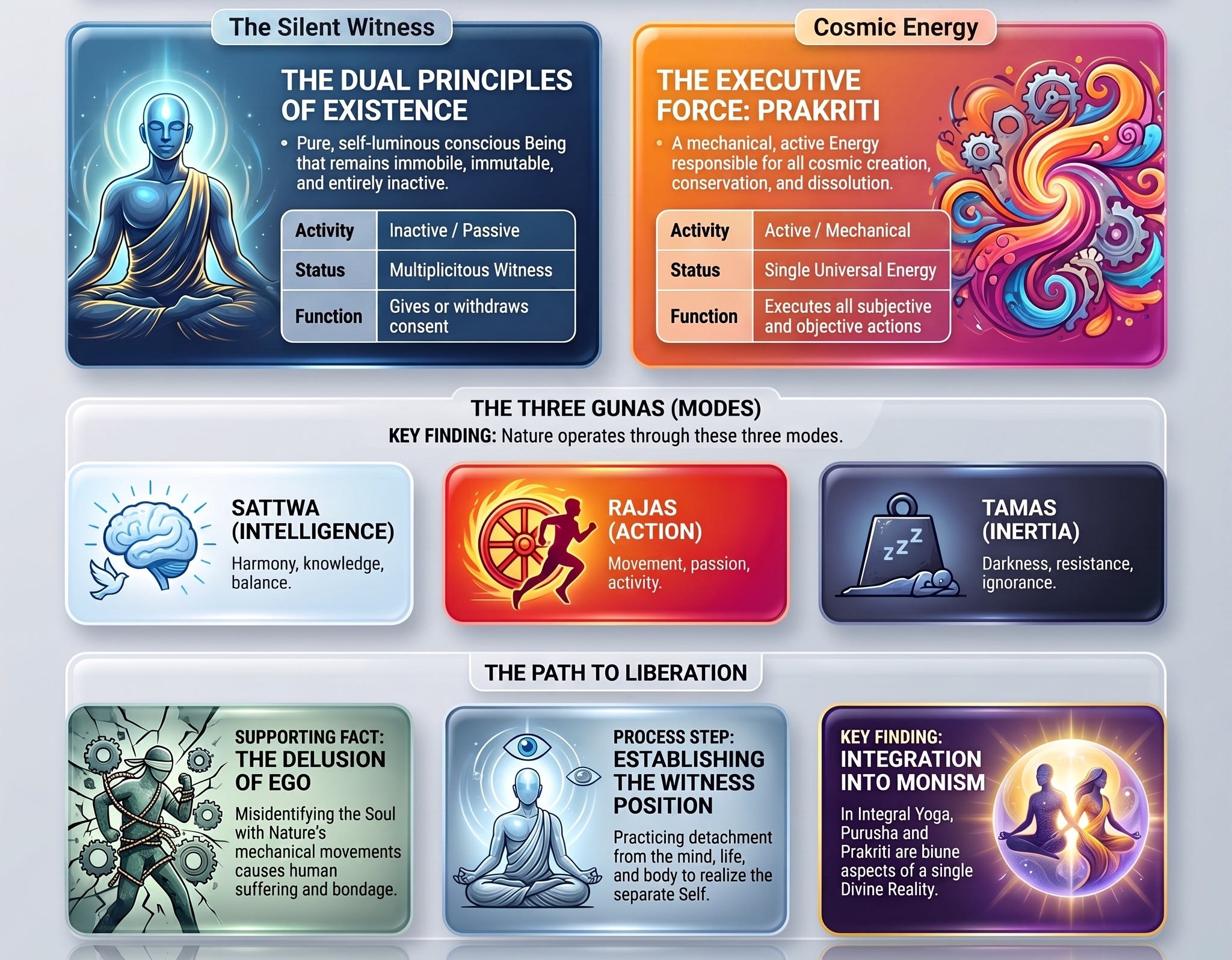
...by two original principles whose inter-relation is the cause of the universe — Purusha, the inactive, Prakriti, the active. Purusha is the Soul, not in the ordinary or popular sense of the word, but of pure conscious Being immobile, immutable and self-luminous. Prakriti is Energy and its process. Purusha does nothing, but it reflects the action of Energy and its processes; Prakriti is mechanical, but by being reflected in Purusha it assumes the appearance of consciousness in its activities, and thus there are created those phenomena of creation, conservation, dissolution, birth and life and death, consciousness and unconsciousness, sense-knowledge and intellectual knowledge and ignorance, action and inaction, happiness and suffering which the Purusha under the influence of Prakriti attributes to itself although they belong not at all to itself but to the action or movement of Prakriti alone.
For Prakriti is constituted of three guṇas or essential modes of energy; sattwa, the seed of intelligence, conserves the workings of energy; rajas, the seed of force and action, creates the workings of energy; tamas, the seed of inertia and non-intelligence, the denial of sattwa and rajas, dissolves what they create and conserve. When these three powers of the energy of Prakriti are in a state of equilibrium, all is in rest, there is no movement, action or creation and there is therefore nothing to be reflected in the immutable luminous being of the conscious Soul. But when the equilibrium is disturbed, then the three gunas fall into a state of inequality in which they strive with and act upon each other and the whole inextricable business of ceaseless creation, conservation and dissolution begins, unrolling the phenomena of the cosmos. This continues so long as the Purusha consents to reflect the disturbance which obscures his eternal nature and attributes to it the nature of Prakriti; but when he withdraws his consent, the gunas fall into equilibrium and the soul returns to its eternal, unchanging immobility; it is delivered from phenomena. This reflection and this giving or withdrawal of consent seem to be the only powers of Purusha; he is the witness of Nature by virtue of reflection and the giver of the sanction.... Even his giving of consent is passive and his withdrawing of consent is only another passivity. All action subjective or objective is foreign to the Soul; it has neither an active will nor an active intelligence....
But whence then come this conscious intelligence and conscious will which we perceive to be so large a part of our being and which we commonly and instinctively refer not to the Prakriti, but to the Purusha? According to the Sankhya this intelligence and will are entirely a part of the mechanical energy of Nature and are not properties of the soul; they are the principle of Buddhi, one of the twenty-four tattvas, the twenty-four cosmic principles. Prakriti in the evolution of the world bases herself with her three gunas in her as the original substance of things, unmanifest, inconscient, out of which are evolved successively five elemental conditions of energy or matter — for Matter and Force are the same in the Sankhya philosophy. These are called by the names of the five concrete elements of ancient thought, ether, air, fire, water and earth; but it must be remembered that they are not elements in the modern scientific sense but subtle conditions of material energy and nowhere to be found in their purity in the gross material world. All objects are created by the combination of these five subtle conditions or elements. Again, each of these five is the base of one of five subtle properties of energy or matter, sound, touch, form, taste and smell, which constitute the way in which the mind-sense perceives objects. Thus by these five elements of Matter put forth from primary energy and these five sense relations through which Matter is known is evolved what we would call in modern language the objective aspect of cosmic existence.
Thirteen other principles constitute the subjective aspect of the cosmic Energy — Buddhi or Mahat, Ahankara, Manas and its ten sense-functions, five of knowledge, five of action. Manas, mind, is the original sense which perceives all objects and reacts upon them; for it has at once an inferent and an efferent activity, receives by perception what the Gita calls the outward touches of things, bāhya sparśa, and so forms its idea of the world and exercises its reactions of active vitality. But it specialises its most ordinary functions of reception by aid of the five perceptive senses of hearing, touch, sight, taste and smell, which make the five properties of things their respective objects, and specialises certain necessary vital functions of reaction by aid of the five active senses which operate for speech, locomotion, the seizing of things, ejection and generation.
Buddhi, the discriminating principle, is at once intelligence and will; it is that power in Nature which discriminates and coordinates. Ahankara, the ego-sense, is the subjective principle in Buddhi by which the Purusha is induced to identify himself with Prakriti and her activities. But these subjective principles are themselves as mechanical, as much a part of the inconscient energy as those which constitute her objective operations.... Sankhya explains what modern Science leaves in obscurity, the process by which the mechanical and inconscient takes on the appearance of consciousness. It is because of the reflection of Prakriti in Purusha; the light of consciousness of the Soul is attributed to the workings of the mechanical energy and it is thus that the Purusha, observing Nature as the witness and forgetting himself, is deluded with the idea generated in her that it is he who thinks, feels, wills, acts, while all the time the operation of thinking, feeling, willing, acting is conducted really by her and her three modes and not by himself at all. To get rid of this delusion is the first step towards the liberation of the soul from Nature and her works.
There are certainly plenty of things in our existence which the Sankhya does not explain at all or does not explain satisfactorily, but if all we need is a rational explanation of the cosmic processes in their principles as a basis for the great object common to the ancient philosophies, the liberation of the soul from the obsession of cosmic Nature, then the Sankhya explanation of the world and the Sankhya way of liberation seem as good and as effective as any other.
What we do not seize at first is why it should bring in an element of pluralism into its dualism by affirming one Prakriti, but many Purushas. It would seem that the existence of one Purusha and one Prakriti should be sufficient to account for the creation and procession of the universe. But the Sankhya was bound to evolve pluralism by its rigidly analytical observation of the principles of things. First, actually, we find that there are many conscious beings in the world and each regards the same world in his own way and has his independent experience of its subjective and objective things, his separate dealings with the same perceptive and reactive processes. If there were only one Purusha, there would not be this central independence and separativeness, but all would see the world in an identical fashion and with a common subjectivity and objectivity. Because Prakriti is one, all witness the same world; because her principles are everywhere the same, the general principles which constitute internal and external experience are the same for all; but the infinite difference of view and outlook and attitude, action and experience and escape from experience — a difference not of the natural operations which are the same but of the witnessing consciousness— are utterly inexplicable except on the supposition that there is a multiplicity of witnesses, many Purushas....
There is another difficulty quite as formidable. Liberation is the object set before itself by this philosophy as by others. This liberation is effected, we have said, by the Purusha’s withdrawal of his consent from the activities of Prakriti which she conducts only for his pleasure; but, in sum, this is only a way of speaking. The Purusha is passive and the act of giving or withdrawing consent cannot really belong to it, but must be a movement in Prakriti itself. If we consider, we shall see that it is, so far as it is an operation, a movement of reversal or recoil in the principle of Buddhi, the discriminative will. Buddhi has been lending itself to the perceptions of the mind-sense; it has been busy discriminating and coordinating the operations of the cosmic energy and by the aid of the ego-sense identifying the Witness with her works of thought, sense and action. It arrives by the process of discriminating things at the acid and dissolvent realisation that this identity is a delusion; it discriminates finally the Purusha from Prakriti and perceives that all is mere disturbance of the equilibrium of the gunas; the Buddhi, at once intelligence and will, recoils from the falsehood which it has been supporting and the Purusha, ceasing to be bound, no longer associates himself with the interest of the mind in the cosmic play. The ultimate result will be that Prakriti will lose her power to reflect herself in the Purusha; for the effect of the ego-sense is destroyed and the intelligent will becoming indifferent ceases to be the means of her sanction: necessarily then her gunas must fall into a state of equilibrium, the cosmic play must cease, the Purusha return to his immobile repose.
But if there were only the one Purusha and this recoil of the discriminating principle from its delusions took place, all cosmos would cease. As it is, we see that nothing of the kind happens. A few beings among innumerable millions attain to liberation or move towards it; the rest are in no way affected, nor is cosmic Nature in her play with them one whit inconvenienced by this summary rejection which should be the end of all her processes. Only by the theory of many independent Purushas can this fact be explained.... Here too we see that the multiplicity of souls is an inevitable conclusion from the data of the Sankhya analysis of existence. [EG 71‒76, Arya 15-3-17]
Purusha and Prakriti in the Integral Yoga
There are Two who are One and play in many worlds;
In Knowledge and Ignorance they have spoken and met
And light and darkness are their eyes’ interchange;
Our pleasure and pain are their wrestle and embrace,
Our deeds, our hopes are intimate to their tale;
They are married secretly in our thought and life.
— Sri Aurobindo, Savitri
In Sri Aurobindo’s Letters on Yoga, there is a section titled “The Central Process of Yoga,” and in it there is a single letter. It begins by contrasting our real Self with what we normally regard as our self.
[T]his little mind, vital and body which we call ourselves is only a surface movement and not our “self” at all. It is an external bit of personality put forward for one brief life and for the play of the Ignorance. It is equipped with an ignorant mind stumbling about in search of fragments of truth, an ignorant vital rushing about in search of fragments of pleasure, an obscure and mostly subconscious physical receiving the impacts of things and suffering rather than possessing a resultant pain or pleasure. All that is accepted until the mind gets disgusted and starts looking about for the real Truth of itself and things, the vital gets disgusted and begins wondering whether there is not such a thing as real bliss and the physical gets tired and wants liberation from itself and its pains and pleasures. Then it is possible for this little ignorant bit of surface personality to get back to its real Self and with it to these greater things — or else to extinction of itself, Nirvana.
The real Self is not anywhere on the surface but deep within and above. Within is the soul supporting an inner mind, inner vital, inner physical in which there is a capacity for universal wideness and with it for the things now asked for — direct contact with the Truth of self and things, taste of a universal bliss, liberation from the imprisoned smallness and sufferings of the gross physical body.... It is, according to our psychology, connected with the small outer personality by certain centres of consciousness of which we become aware by Yoga.
Only a little of the inner being escapes through these centres into the outer life, but that little is the best part of ourselves and responsible for our art, poetry, philosophy, ideals, religious aspirations, efforts at knowledge and perfection. But the inner centres are, for the most part, closed or asleep — to open them and make them awake and active is one aim of Yoga. As they open, the powers and possibilities of the inner being also are aroused in us; we awake first to a larger consciousness and then to a cosmic consciousness; we are no longer little separate personalities with limited lives but centres of a universal action and in direct contact with cosmic forces. Moreover, instead of being unwilling playthings of the latter, as is the surface person, we can become to a certain extent conscious and masters of the play of nature — how far this goes depending on the development of the inner being and its opening upward to the higher spiritual levels. At the same time the opening of the heart centre releases the psychic being which proceeds to make us aware of the Divine within us and of the higher Truth above us.
Sri Aurobindo goes on to explain that the highest spiritual Self resides above the head, manifesting both as a static, detached Peace, which has the power to dissolve the ego, and as a dynamic cosmic force, which supports all universal action. Opening upward to this transcendent consciousness introduces an influx of Light, Power and Ananda. For this transformation to be safe, a stable foundation of Peace must first be established, for without it the external human nature cannot contain or endure the sheer intensity of these divine forces. Once Peace is secured, the Divine Force descends through the body’s energy centers — from the head down to the heart, navel, and base of the spine — to systematically liberate and restructure the mind, emotions, vital energies, and physical being. The letter continues:
All this is prepared, assisted, farthered by the work of the psychic being in the heart centre; the more it is open, in front, active, the quicker, safer, easier the working of the Force can be. The more love and bhakti and surrender grow in the heart, the more rapid and perfect becomes the evolution of the sadhana. For the descent and transformation imply at the same time an increasing contact and union with the Divine.
That is the fundamental rationale of the sadhana. It will be evident that the two most important things here are the opening of the heart centre and the opening of the mind centres to all that is behind and above them. For the heart opens to the psychic being and the mind centres open to the higher consciousness and the nexus between the psychic being and the higher consciousness is the principal means of the siddhi. The first opening is effected by a concentration in the heart, a call to the Divine to manifest within us and through the psychic to take up and lead the whole nature. Aspiration, prayer, bhakti, love, surrender are the main supports of this part of the sadhana — accompanied by a rejection of all that stands in the way of what we aspire for. The second opening is effected by a concentration of the consciousness in the head (afterwards, above it) and an aspiration and call and a sustained will for the descent of the divine Peace, Power, Light, Knowledge, Ananda into the being — the Peace first or the Peace and Force together....
The result of the concentration is not usually immediate.... The coming of the result can sometimes be aided by associating with the concentration one of the processes of the old Yogas. There is the Adwaita process of the way of knowledge — one rejects from oneself the identification with the mind, vital, body, saying continually “I am not the mind”, “I am not the vital”, “I am not the body”, seeing these things as separate from one’s real self — and after a time one feels all the mental, vital, physical processes and the very sense of mind, vital, body becoming externalised, an outer action, while within and detached from them there grows the sense of a separate self-existent being which opens into the realisation of the cosmic and transcendent Spirit. There is also the method — a very powerful method — of the Sankhyas, the separation of the Purusha and the Prakriti. One enforces on the mind the position of the Witness — all action of mind, vital, physical becomes an outer play which is not myself or mine, but belongs to Nature and has been enforced on an outer me. I am the witness Purusha who am silent, detached, not bound by any of these things. There grows up in consequence a division in the being; the sadhak feels within him the growth of a calm silent separate consciousness which feels itself quite apart from the surface play of the mind and the vital and physical Nature. Usually when this takes place, it is possible very rapidly to bring down the peace of the higher consciousness and the action of the higher Force and the full march of the Yoga. [LY III: 324‒29]
Purusha and Prakriti in Sri Aurobindo’s Integral Monism
Thus have they made their play with us for roles:
Author and actor with himself as scene,
He moves there as the Soul, as Nature she.
— Sri Aurobindo, Savitri
Sankhya asserts that Prakriti’s movements are entirely driven by two specific purposes or goals: providing the soul with the grand theater of material existence to experience and enjoy life, and serving as the vehicle for the soul’s ultimate liberation. By presenting the soul with limitations and suffering, Prakriti eventually drives the soul to realize its complete independence from matter.
While providing an incredibly useful psychological scaffold for personal liberation, as a metaphysical system Sankhya leaves many questions unanswered or even unanswerable. What gives Prakriti the power to ensnare the soul, and what gives the soul the power to uphold or assent to her play? If Purusha is pure, immutable, and actionless consciousness, and Prakriti is entirely unconscious, mechanical energy, who pulls the trigger on the first glance? If the actual mechanics of witnessing — the cognitive processing of sight, the sensory focusing, the vital reaction, the emotional evaluation — take place entirely within Prakriti’s domain, how can the Purusha be the one that witnesses? How does Nature construct her psychological trap?
According to Sankhya, the mechanical instruments of Nature become conscious by reflecting the light of the Spirit like a mirror, yet every relation between two entities, including the reflection of one by the other, seems impossible without their prior identity. If Prakriti is able to mimic awareness because of the Buddhi’s “proximity” to the Purusha, as Sankhya claims, how does one measure or define the distance between the two? Ditto if it the claim is that the evolution of the manifest universe is triggered by the nearness of the Purusha to Prakrti, which “disturbs” the equilibrium of the Gunas in her unmanifest state (Avyakta).
Let us now see how the duality of Purusha-Prakriti fits into the Integral Monism of Sri Aurobindo. In The Life Divine, Book One, Sri Aurobindo discusses the three aspects of Sachchidananda in Chapters IX, X, and XI‒XII, respectively. Chapter IX (“The Pure Existent,” sat) closes with a question, to which Chapter X (“Conscious Force,” cit) provides the answer.
We have seen what pure Reason, intuition and experience have to say about pure Existence, about Sat; what have they to say about Force, about Movement, about Shakti? And the first thing we have to ask ourselves is whether that Force is simply force, simply an unintelligent energy of movement or whether the consciousness which seems to emerge out of it in this material world we live in, is not merely one of its phenomenal results but rather its own true and secret nature. In Vedantic terms, is Force simply Prakriti, only a movement of action and process, or is Prakriti really power of Chit, in its nature force of creative self-conscience? On this essential problem all the rest hinges. [LD 85‒86]
Restating the triune nature of Sachchidananda at the beginning of Chapter XII, Sri Aurobindo mentions an aspect of his philosophical project, which is to reconcile “the divergent formulae of the old philosophies”:
The self of things is an infinite indivisible existence; of that existence the essential nature or power is an infinite imperishable force of self-conscious being; and of that self-consciousness the essential nature or knowledge of itself is, again, an infinite inalienable delight of being.... As we look at these three aspects of essential Being, one in reality, triune to our mental view, separable only in appearance, in the phenomena of the divided consciousness, we are able to put in their right place the divergent formulae of the old philosophies so that they unite and become one, ceasing from their agelong controversy.
For if we regard world-existence only in its appearances and only in its relation to pure, infinite, indivisible, immutable Existence, we are entitled to regard it, describe it and realise it as Maya.... If, on the other hand, we look at world-existence in relation to consciousness only and to force of consciousness, we may regard, describe and realise it as a movement of Force obeying some secret will or else some necessity imposed on it by the very existence of the Consciousness that possesses or regards it. It is then the play of Prakriti, the executive Force, to satisfy Purusha, the regarding and enjoying Conscious-Being or it is the play of Purusha reflected in the movements of Force and with them identifying himself....
Again if we look at World-Existence rather in its relation to the self-delight of eternally existent being, we may regard, describe and realise it as Lila, the play, the child’s joy, the poet’s joy, the actor’s joy, the mechanician’s joy of the Soul of things eternally young, perpetually inexhaustible, creating and re-creating Himself in Himself for the sheer bliss of that self-creation, of that self-representation — Himself the play, Himself the player, Himself the playground. These three generalisations of the play of existence in its relation to the eternal and stable, the immutable Sachchidananda, starting from the three conceptions of Maya, Prakriti and Lila and representing themselves in our philosophical systems as mutually contradictory philosophies, are in reality perfectly consistent with each other, complementary and necessary in their totality to an integral view of life and the world. [LD 108‒11]
In Chapter II of Book Two (“Brahman, Purusha, Ishwara — Maya, Prakriti, Shakti”), Sri Aurobindo discusses a closely related triad of dualities. There is a realization where Brahman the Reality is experienced as “an immobile immutable being, self-existent, pervading the whole universe, omnipresent in all, but not dynamic or active, aloof from the ever mobile energy of Maya”.1 There is another realization of Brahman as...
...the Purusha, separate from Prakriti, the Conscious Being standing back from the activities of Nature. But this is an exclusive concentration which limits itself to a spiritual status and puts away from it all activity in order to realise the freedom of Brahman the self-existent Reality from all limitation by its own action and manifestation: it is an essential realisation, but not the total realisation. For we can see that the Conscious-Power, the Shakti that acts and creates, is not other than the Maya or all-knowledge of Brahman; it is the Power of the Self; Prakriti is the working of the Purusha, Conscious Being active by its own Nature: the duality then of Soul and World-Energy, silent Self and the creative Power of the Spirit, is not really something dual and separate, it is biune....
As the aspect of Self is in its essential character transcendental even when involved and identified with its universal and individual becomings, so the Purusha aspect is characteristically universal-individual and intimately connected with Nature even when separated from her. For this conscious Spirit while retaining its impersonality and eternity, its universality, puts on at the same time a more personal aspect; it is the impersonal-personal being in Nature from whom it is not altogether detached, for it is always coupled with her: Nature acts for the Purusha and by its sanction, for its will and pleasure; the Conscious Being imparts its consciousness to the Energy we call Nature, receives in that consciousness her workings as in a mirror, accepts the forms which she, the executive cosmic Force, creates and imposes on it, gives or withdraws its sanction from her movements.
The experience of Purusha-Prakriti, the Spirit or Conscious Being in its relations to Nature, is of immense pragmatic importance; for on these relations the whole play of the consciousness depends in the embodied being. If the Purusha in us is passive and allows Nature to act, accepting all she imposes on him, giving a constant automatic sanction, then the soul in mind, life, body, the mental, vital, physical being in us, becomes subject to our nature, ruled by its formation, driven by its activities; that is the normal state of our ignorance. If the Purusha in us becomes aware of itself as the Witness and stands back from Nature, that is the first step to the soul’s freedom; for it becomes detached, and it is possible then to know Nature and her processes and in all independence, since we are no longer involved in her works, to accept or not to accept, to make the sanction no longer automatic but free and effective; we can choose what she shall do or not do in us, or we can stand back altogether from her works and withdraw into the Self’s spiritual silence, or we can reject her present formations and rise to a spiritual level of existence and from there re-create our existence. The Purusha can cease to be subject, anīśa, and become lord of its nature, īśvara.
In the philosophy of the Sankhyas we find developed most thoroughly the metaphysical idea of Purusha-Prakriti. These two are eternally separate entities, but in relation to each other. Prakriti is Nature-power, an executive Power, it is Energy apart from Consciousness; for Consciousness belongs to the Purusha, Prakriti without Purusha is inert, mechanical, inconscient. Prakriti develops as its formal self and basis of action primal Matter and in it manifests life and sense and mind and intelligence; but intelligence too, since it is part of Nature and its product in primal Matter, is also inert, mechanical, inconscient — a conception which sheds a certain light on the order and perfectly related workings of the Inconscient in the material universe: it is the light of the soul, the Spirit, that is imparted to the mechanical workings of sense-mind and intelligence, they become conscious by its consciousness, even as they become active only by the assent of the spirit. The Purusha becomes free by drawing back from Prakriti; it becomes master of her by refusing to be involved in Matter. Nature acts by three principles, modes or qualities of its stuff and its action, which in us become the fundamental modes of our psychological and physical substance and its workings, the principle of inertia, the principle of kinesis and the principle of balance, light and harmony: when these are in unequal motion, her action takes place; when they fall into equilibrium she passes into quiescence. Purusha, conscious being, is plural, not one and single, while Nature is one: it would seem to follow that whatever principle of oneness we find in existence belongs to Nature, but each soul is independent and unique, sole to itself and separate whether in its enjoyment of Nature or its liberation from Nature.
All these positions of the Sankhya we find to be perfectly valid in experience when we come into direct inner contact with the realities of individual soul and universal Nature; but they are pragmatic truths and we are not bound to accept them as the whole or the fundamental truth either of self or of Nature. Prakriti presents itself as an inconscient Energy in the material world, but, as the scale of consciousness rises, she reveals herself more and more as a conscious force and we perceive that even her inconscience concealed a secret consciousness; so too conscious being is many in its individual souls, but in its self we can experience it as one in all and one in its own essential existence. Moreover, the experience of soul and Nature as dual is true, but the experience of their unity has also its validity. If Nature or Energy is able to impose its forms and workings on Being, it can only be because it is Nature or Energy of Being and so the Being can accept them as its own; if the Being can become lord of Nature, it must be because it is its own Nature which it had passively watched doing its work, but can control and master; even in its passivity its consent is necessary to the action of Prakriti and this relation shows sufficiently that the two are not alien to each other. The duality is a position taken up, a double status accepted for the operations of the self-manifestation of the being; but there is no eternal and fundamental separateness and dualism of Being and its Consciousness-Force, of the Soul and Nature.
It is the Reality, the Self, that takes the position of the Conscious Being regarding and accepting or ruling the works of its own Nature. An apparent duality is created in order that there may be a free action of Nature working itself out with the support of the Spirit and again a free and masterful action of the Spirit controlling and working out Nature. This duality is also necessary that the Spirit may be at any time at liberty to draw back from any formation of its Nature and dissolve all formation or accept or enforce a new or a higher formation....
The Purusha aspect and the Prakriti aspect go always together and whatever status Nature or Consciousness-force in action assumes, manifests or develops, there is a corresponding status of the Spirit. In its supreme status the Spirit is the supreme Conscious Being, Purushottama, and the Consciousness-Force is his supreme Nature, Para-Prakriti. In each status of the gradations of Nature, the Spirit takes a poise of its being proper to that gradation; in Mind-Nature it becomes the mental being, in Life-Nature it becomes the vital being, in nature of Matter it becomes the physical being, in supermind it becomes the Being of Knowledge; in the supreme spiritual status it becomes the Being of Bliss and pure Existence. In us, in the embodied individual, it stands behind all as the psychic Entity, the inner Self supporting the other formulations of our consciousness and spiritual existence.... But it is evident that whatever the posture taken or relation formed in any individual nodus of Purusha-Prakriti, the Being is in a fundamental cosmic relation lord or ruler of its nature: for even when it allows Nature to have its own way with it, its consent is necessary to support her workings.
This comes out in its fullest revelation in the third aspect of the Reality, the Divine Being who is the master and creator of the universe. Here the supreme Person, the Being in its transcendental and cosmic consciousness and force, comes to the front, omnipotent, omniscient, the controller of all energies, the Conscious in all that is conscient or inconscient, the Inhabitant of all souls and minds and hearts and bodies, the Ruler or Overruler of all works, the Enjoyer of all delight, the Creator who has built all things in his own being, the All-Person of whom all beings are personalities, the Power from whom are all powers, the Self, the Spirit in all, by his being the Father of all that is, in his Consciousness-Force the Divine Mother, the Friend of all creatures, the All-blissful and All-beautiful of whom beauty and joy are the revelation, the All-Beloved and All-Lover. In a certain sense, so seen and understood, this becomes the most comprehensive of the aspects of the Reality, since here all are united in a single formulation; for the Ishwara is supracosmic as well as intracosmic; He is that which exceeds and inhabits and supports all individuality; He is the supreme and universal Brahman, the Absolute, the supreme Self, the supreme Purusha.... Ishwara is Brahman the Reality, Self, Spirit, revealed as possessor, enjoyer of his own self-existence, creator of the universe and one with it, Pantheos, and yet superior to it, the Eternal, the Infinite, the Ineffable, the Divine Transcendence. [LD 361‒67]
Exclusive concentration
There remains one question that deserves to be answered in more detail. What exactly differentiates Sri Aurobindo’s integral monism from the dualistic architecture of Sankhya? There is of course the Purushottama, the Para Purusha, the Ishwara who encompasses and transcends the duality of Purusha and Prakriti. There is not only the lower Prakriti of the Sankhya but also the higher Para-Prakriti. And while Sankhya uses the soul’s sanction or assent as an off-switch to secure an escape from Nature, Sri Aurobindo turns the same into a means or condition for ascent and transformation. But what precisely fills the Sankhya’s gap between Purusha and Prakriti, which in the Aurobindonian system becomes the space between “Spirit in which all is involved and out of which all evolves downward to the other pole of Matter” and “Matter in which also all is involved and out of which all evolves upward to the other pole of Spirit” [LD 137]? This way of putting the question gives away part of the answer: the two ends of creation are joined by a process by which Spirit gets involved in Matter, and which sets the stage for the Spirit’s adventure of evolution. But what is the nature of this process? On what mechanism does it rely? The answer in a word is: exclusive concentration of Consciousness-Force (Chit-Tapas). For more on this subject, watch this space.
This realization is far from being the whole truth of Maya. To the Vedic seers, the term meant “the power of infinite consciousness to comprehend, contain in itself and measure out, that is to say, to form — for form is delimitation — Name and Shape out of the vast illimitable Truth of infinite existence. It is by Maya that static truth of essential being becomes ordered truth of active being — or, to put it in more metaphysical language, out of the supreme being in which all is all without barrier of separative consciousness emerges the phenomenal being in which all is in each and each is in all for the play of existence with existence, consciousness with consciousness, force with force, delight with delight.” [LD 123‒24]
One of the most important posts in my opinion, as regards to the middle section.
Regarding the first and last parts, I’ve read many accounts of Sankhya dualism, just to name a few (by looking around): Hiriyanna, Eliade, Radhakrishnan, TW Organ.. and none comes even close to Sri Aurobindo’s. His clarity, conciseness and brilliancy are simply unmatched. Even Zimmer is left wanting.
“But in sum, this is only a way of speaking..” This part is just extraordinary, you can see the multiple branches of eastern philosophical tradition, spanning an entire continent through millennia, step forth from that singular explanation. For example, no one who has ever approached the standpoint of zen with a inquisitive mind would have failed to notice that as a philosophy, it is the ultimate “acid”, the great “dissolvent”. At least that’s the way I’ve always seen it. Here the problem is presented from an even more interesting angle.
As a side note, not sure if anyone has ever mentioned this, but there is an obvious parallelism in that encompassing presentation of Sachchidananda by Sri Aurobindo and the triune universals of Nishida. The first one would obviously correspond to the universal of judgement (being-Maya), the second level to the universal of self-consciousness (self-Prakriti) and the last one to the intelligible universal (value-Lila). His integration, or rather “theirs”, has already proved its internal consistency. I’m saying this just as an unrequested and, more importantly, unnecessary confirmation of his purported synthesis.
Reinforcing the analogy I just mentioned, it has already been highlighted multiple times (e.g D. L. Roy’s Nonduality) the intercompatibility of any unified system that rejects dualism, like Advaita Vedānta or the case of integral monism, and a philosophy of emptiness:
“It is difficult indeed to distinguish between pure being and pure nonbeing as a category.” (Dasgupta, History of Indian Philosophy, 1, quoted above II.5, p.208)
In terms of praxis therefore, as Huxley would put it, there is only one road to Rouen. Maybe the same can be said as regards to theory or, more accurately, both are in fact indistinguishable.
“Our earth is round, and it is therefore possible to travel from Paris to Rouen via Shanghai. Our history, on the contrary, would seem to be flat. Those who wish to reach a specific historical goal must advance directly towards it; no amount of walking in the opposite direction will bring them to their destination.”
(Ends and Means, VII, p.62, 1937)