
Shut up and meditate
How to arrive at a deeper understanding
The title is an obvious riff on David Mermin’s “Shut up and calculate” (often, like so many sayings, misattributed to Richard Feynman).
I don’t feel like saying anything. Everything worth saying has been said hundreds of times. Everything not worth saying has been said a million times. It’s time to shut up, grab the popcorn, and let events unfold.
Meanwhile, a word in support of shutting up. What follows is from “The Intuitive Mind,” a chapter of Sri Aurobindo’s The Synthesis of Yoga. It was originally published in the Arya’s issue of July 1920.
The original nature of supermind is the self-conscience and all-conscience of the Infinite, of the universal Spirit and Self in things, organising on the foundation and according to the character of a direct self-knowledge its own wisdom and effective omnipotence for the unfolding and the regulated action of the universe and of all things in the universe.... As it knows itself, so too it knows all things — for all are only becomings of itself — directly, totally and from within outward, spontaneously in detail and arrangement, each thing in the truth of itself and its nature and in its relation to all other things. And it knows similarly all action of its energy in antecedent or cause and occasion of manifestation and effect or consequence, all things in infinite and in limited potentiality and in selection of actuality and in their succession of past, present and future....
[I]n man any emergence of the supermind must be a gradual and at first an imperfect creation and to his customary mind the activity of an exceptional and supernormal will and knowledge. In the first place it will not be for him a native power always enjoyed without interruption, but a secret potentiality which has to be discovered and one for which there are no organs in his present physical or mental system: he has either to evolve a new organ for it or else to adopt or transform existing ones and make them utilisable for the purpose. He has not merely to uncover the hidden sun of the supermind in the subliminal cavern of his secret being or remove the cloud of his mental ignorance from its face in the spiritual skies so that it shall at once shine out in all its glory. His task is much more complex and difficult because he is an evolutionary being and by the evolution of Nature of which he is a part he has been constituted with an inferior kind of knowledge, and this inferior, this mental power of knowledge forms by its persistent customary action an obstacle to a new formation greater than its own nature.
[The sense mind, the intelligence, the reason] by which he is at present distinguished from all other terrestrial creatures ... are the instruments in which he has learned to put his trust and he has erected by their means certain foundations which he is not over willing to disturb and has traced limits outside of which he feels all to be confusion, uncertainty and a perilous adventure. Moreover the transition to the higher principle means not only a difficult conversion of his whole mind and reason and intelligence, but in a certain sense a reversal of all their methods. The soul climbing above a certain critical line of change sees all its former operations as an inferior and ignorant action and has to effect another kind of working which sets out from a different starting-point and has quite another kind of initiation of the energy of the being....
In fact the change is only possible if there is first a spiritual development on our present level of consciousness and it can only be undertaken securely when the mind has become aware of the greater self within, enamoured of the Infinite and confident of the presence and guidance of the Divine and his Shakti.
The problem of this conversion resolves itself at first into a passage through a mediary status and by the help of the one power already at work in the human mind which we can recognise as something supramental in its nature or at least in its origin, the faculty of intuition, a power of which we can feel the presence and the workings and are impressed, when it acts, by its superior efficiency, light, direct inspiration and force, but cannot understand or analyse it as we understand or analyse the workings of our reason....
The power of intuition acts in us at present for the most part in a covert manner secret and involved in or mostly veiled by the action of the reason and the normal intelligence; so far as it emerges into a clear separate action, it is still occasional, partial, fragmentary and of an intermittent character. It casts a sudden light, it makes a luminous suggestion or it throws out a solitary brilliant clue or scatters a small number of isolated or related intuitions, lustrous discriminations, inspirations or revelations, and it leaves the reason, will, mental sense or intelligence to do what each can or pleases with this seed of succour that has come to them from the depths or the heights of our being.
The mental powers immediately proceed to lay hold on these things and to manipulate and utilise them for our mental or vital purposes, to adapt them to the forms of the inferior knowledge, to coat them up in or infiltrate them with the mental stuff and suggestion, often altering their truth in the process and always limiting their potential force of enlightenment by these accretions and by this subdual to the exigencies of the inferior agent, and almost always they make at once too little and too much of them, too little by not allowing them time to settle and extend their full power for illumination, too much by insisting on them or rather on the form into which the mentality casts them to the exclusion of the larger truth that the more consistent use of the intuitive faculty might have given....
It appears at once that there are two necessary lines of progress which we must follow, and the first is to extend the action of the intuition and make it more constant, more persistent and regular and all-embracing until it is so intimate and normal to our being that it can take up all the action now done by the ordinary mind and assume its place in the whole system. This cannot wholly be done so long as the ordinary mind continues to assert its power of independent action and intervention or its habit of seizing on the light of the intuition and manipulating it for its own purposes. The higher mentality cannot be complete or secure so long as the inferior intelligence is able to deform it or even to bring in any of its own intermixture. And either then we must silence altogether the intellect and the intellectual will and the other inferior activities and leave room only for the intuitive action or we must lay hold on and transform the lower action by the constant pressure of the intuition.... [W]hen we learn to insist on no particular method as exclusively the right one and leave the whole movement to a greater guidance, we find that the divine Lord of the Yoga commissions his Shakti to use one or the other at different times and all in combination according to the need and turn of the being and the nature.
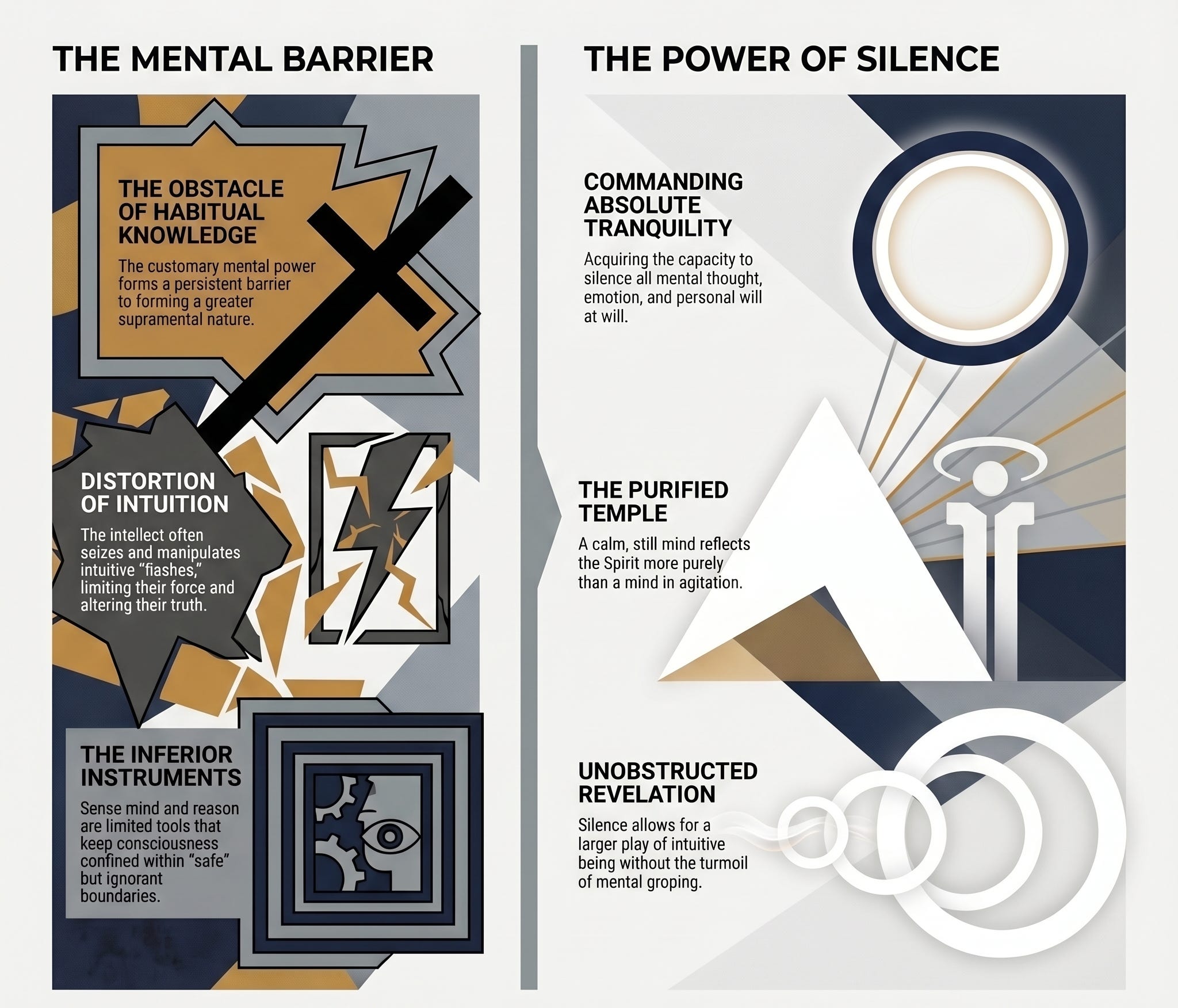
At first it might seem the straight and right way to silence the mind altogether, to silence the intellect, the mental and personal will, the desire mind and the mind of emotion and sensation, and to allow in that perfect silence the Self, the Spirit, the Divine to disclose himself and leave him to illuminate the being by the supramental light and power and Ananda. And this is indeed a great and powerful discipline. It is the calm and still mind much more readily and with a much greater purity than the mind in agitation and action that opens to the Infinite, reflects the Spirit, becomes full of the Self and awaits like a consecrated and purified temple the unveiling of the Lord of all our being and nature. It is true also that the freedom of this silence gives a possibility of a larger play of the intuitive being and admits with less obstruction and turmoil of mental groping and seizing the great intuitions, inspirations, revelations which emerge from within or descend from above. It is therefore an immense gain if we can acquire the capacity of always being able at will to command an absolute tranquillity and silence of the mind free from any necessity of mental thought or movement and disturbance and, based in that silence, allow thought and will and feeling to happen in us only when the Shakti wills it and when it is needful for the divine purpose. [SY 799‒803]
We hang on to the spark of those imperfect perfections, and build a little life around them, like one who nurtures a fire. In the thought that we will never be entitled to the other, “perfect perfection”, at least not in this lifetime.
“However crude all this may be, it proves that Man has a feeling that he is truly represented in something which exceeds himself. He is aware that he is not imperfect, but incomplete. He knows that in himself some meaning has yet to be realized. We do not feel the wonder of it, because it seems so natural to us that barbarism in Man is not absolute, that its limits are like the limits of the horizon.
On the occasions when these are overcome, our inner self is filled with joy, which indicates that through such freedom we come into touch with the Reality that is an end in itself and therefore is bliss.”
(Tagore, The Religion of Man, p. 36-41, 1931)