
Matter from consciousness
Aurobindonian thoughts on Bernardo Kastrup's Analytic Idealism/Rationalist Spirituality
There have been many attempts to explain the emergence of consciousness from a material substrate, none having met with much success, to say the least.1 There also have been attempts to explain the emergence of matter from consciousness, beginning (in the Western hemisphere) with the idealism of George Berkeley.
For Berkeley, there are two kinds of things: perceivers (like you, me, and God) and things perceived: Esse est percipi (aut percipere) — to be is to be perceived (or to perceive). The central issues to be resolved by any ontology founded on mind or consciousness is to explain (i) the agreement between our respective “spheres of consciousness” (Schrödinger’s term) and (ii) the predictable evolution of unperceived objects. As the famous limerick goes:
There was a young man who said God,
must think it exceedingly odd
if he finds that the tree
continues to be
when no one’s about in the Quad.
Berkeley’s reply:
Dear Sir, your astonishment’s odd
I am always about in the Quad
And that’s why the tree
continues to be
since observed by, Yours faithfully, God.
God is an infinite, omnipresent mind that continuously perceives the “mighty frame of the world,” thereby ensuring that different perceivers share a coherent world.
Although Berkeley does not appear to have used the term, according to some writers he characterized human knowledge as perspectival. What Berkeley seems to have had in mind was the fact that our perceptions present the world from a particular location within the world, i.e., in perspective. This sets human knowledge apart from God’s knowledge which, by the same token, could be characterized as aperspectival.
Another important attempt to explain the emergence of matter from consciousness was made by Hegel. In Hegel’s system the fundamental reality—Geist (Spirit, Mind, or Reason)—is an all-encompassing consciousness undergoing a process of historical self-actualization. To get this process going, the material world had to be created through a mechanism of externalization or self-alienation. The “Mind of God before the creation of nature” lacked “concreteness.” For Spirit to achieve self-consciousness, it must project itself into its opposite: nature or matter. There, it lies “self-forgetful,” “asleep,” “frozen” and/or “fragmented,” governed by mechanical necessity rather than conscious freedom. Yet even in the rocks, plants, and animals, the rational idea is present, working its way back toward consciousness.
Hegel’s world evolves—if evolution it can be called (see below)—through a process called dialectic. Every successive state of being (the thesis) contains an internal contradiction or limitation, which gives rise to its opposite (the antithesis). The tension between the two is then resolved into a higher level of truth (the synthesis).
For an Aurobindonian like me, there is much here that resonates. The Spirit’s self-alienation, the projection of itself into its opposite by fragmentation, its being present if asleep in matter, working its way back toward full consciousness—what an apt elaboration of Sri Aurobindo’s concept of involution preceding evolution (discussed here, here, here, and here).
Furthermore, Hegel’s dialectic chimes with the following central passage from the first chapter of Sri Aurobindo’s The Life Divine: “For all problems of existence are essentially problems of harmony. They arise from the perception of an unsolved discord and the instinct of an undiscovered agreement or unity.”
When it comes to evolution, however, significant differences emerge. To Sri Aurobindo, what is still involved but bound to evolve is a consciousness way above and beyond Geist (mind or reason). Geist is the limit. To Hegel, there is nothing that reason cannot adjudicate. Or if there is such a thing, it is unworthy of consideration, as for example the biological concept of evolution2:
Nature is to be regarded as a system of grades, of which the one necessarily arises out of the other, and is the proximate truth of the one from which it results—but not so that the one were naturally generated out of the other.… It has been an inept conception of earlier and later ‘Naturphilosophie’ to regard the progression and transition of one natural form and sphere into a higher as an outwardly actual production.… Thinking consideration must deny itself such nebulous, at bottom sensuous, conceptions, as is in especial the so-called origin, for example, of ... the more highly developed animal organizations from the lower.
For Hegel, the endless extravagance of natural production reveals the “impotence of nature,” her powerlessness to keep within the bounds of reason.
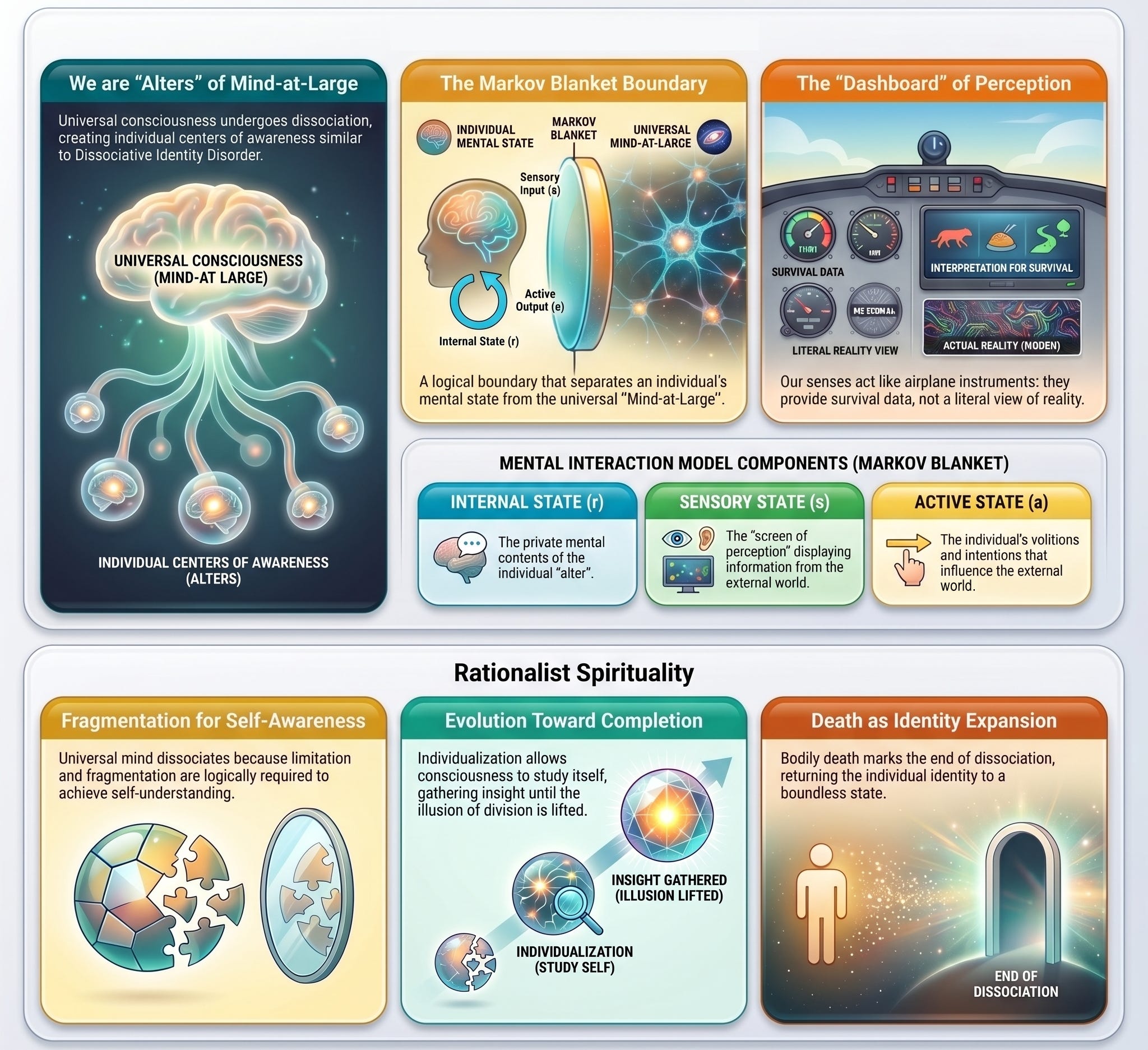
In the modern philosophical landscape, Bernardo Kastrup’s Analytic Idealism provides a sophisticated account of the material world’s emergence from a universal consciousness. To explain how it is that within this universal consciousness, this mind-at-large, there exists a multitude of individual minds, Kastrup invokes the psychiatric condition of Dissociative Identity Disorder (DID, formerly known as Multiple Personality Disorder). DID is characterized by the presence of two or more personalities called “alters.” According to Kastrup, we are the dissociated fragments (alters) of a universal mind.
Each of these centers of self-awareness is bounded by something that, Kastrup maintains, can be mathematically modelled as a Markov blanket. This is a logical boundary, not a boundary in space (or spacetime, or some configuration space). What it includes is the mental state of an alter, and what it excludes is the mental contents of mind-at-large that are logically outside the alter’s dissociative boundary.
The mental contents of mind-at-large precede spacetime ontologically, and “whatever reality precedes spacetime ontologically is unreachable by the human intellect.” It follows that “the notions we construct and the conclusions we reach within the framework of spacetime cannot be ultimately true.” If we nevertheless talk about ultimate reality in spatiotemporal terms, it is “a concession to the limitations of thought and language,” which force us to acknowledge that “this dimensional scaffolding is simply a kind of illusion inherently imposed by the structure of our cognition”.3 While “space and time are qualities of experience,” they are qualities only of an alter’s experience, not qualities of experience per se4:
Time exists only insofar as what we call ‘past’ is an experiential quality characteristic of memory and ‘future’ an experiential quality characteristic of imagined possibilities or expectations. Space, in turn, exists only insofar as it is the experiential quality of a certain relationship between perceived objects.
How then does our shared (spatiotemporal/physical) world come into being? It originates within the Markov blanket separating an alter’s mental state r from the mental state ψ of mind-at-large. An alter’s mental state interacts with the mental state of mind-at-large through its sensory state s and its active state a, both of which located within its Markov Blanket.
Inspired by Donald Hoffman’s multimodal user interface theory of perception, Kastrup makes metaphorical use of a modern airplane’s dashboard. While such a dashboard looks nothing like the sky outside the plane, it conveys important information about the sky. By the same token, what is displayed on an alter’s “screen of perception” s is information useful for the alter’s survival, which looks nothing like the “environment” in which the alter survives. This useful information5 is what we believe to be the world in which we live. “Even our language and our very thoughts have evolved to ‘speak dashboard,’ not ‘reality’.”6 Just as for Kant space and time are the pure forms of human intuition (rather than aspects of the world-in-itself), so for Kastrup they are the dimensions of our screens of perceptions.
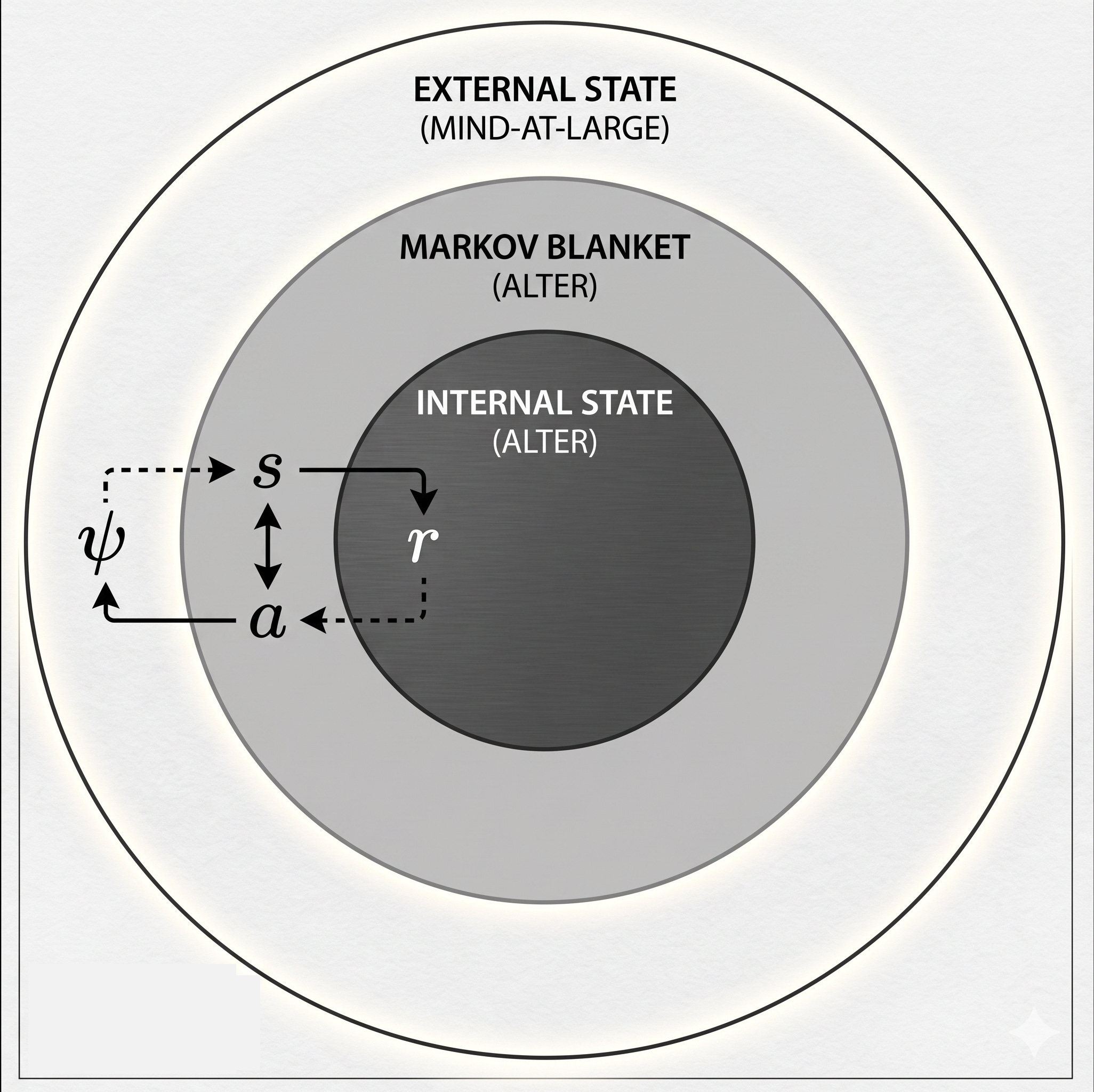
We interact with ψ not only through our sensory state s but also by means of our effective volitions and intentions, which define our active state a. As indicated by the above diagram, s depends not only on ψ but also on a, and this both indirectly via its effects on ψ and directly. To explain the direct action of a on s, Kastrup makes use the dependence of the value of a quantum observable on the experimental arrangement by which it is measured: the outcome observed (“displayed” on s) depends directly on a course of action we choose (as part of a), to wit, which of a pair of complementary experiments we choose to perform. Conversely, a depends not only on r but also on s, and this indirectly (via the effects of s on r, causing deliberation preceding action) as well as directly. An example of a direct influence of s on a could be the spontaneous and potentially life-saving action one sometimes performs in response to a danger that is perceived and reacted to before it is understood as such.
Having his further reflections subjected to the caveat that talking about ultimate reality in spatiotemporal terms is a concession to the limitations of thought and language, Kastrup proceeds by positing that reality is fundamentally quantum. (As quantum mechanics presupposes the existence either of a configuration space or of spacetime, this can at best be a “penultimate truth.”) Kastrup uses Carlo Rovelli’s relational interpretation of quantum mechanics as the basis for his discussion. Like any interpretation of which I am aware, Rovelli assumes that reality can be partitioned into quantum systems. (Nobody has a convincing explanation of where the boundaries between quantum systems might lie.)
When two quantum systems interact, they usually get “entangled,” which simply means that a measurement performed on one system (by an observer external to both systems) also yields information about the other system. Rovelli gets rid of the external observer. Each of a pair of entangled systems plays the role of an observer relative to the other system. In addition he holds that there are no absolute (i.e., observer-independent) physical properties. Physical properties exist only relative to observers (i.e., if and when they are observed), and the properties existing relative to one observer need not be the same as those existing relative to another observer. In relational quantum mechanics, there is no objective world that is shared by all observers.
Kastrup’s Analytical Idealism offers a possible ontological underpinning for our all but incorrigible belief that we live in a single shared world. If we distinguish between things that possess an inner/mental life and things that don’t, calling the former “living” and the latter “inanimate,” we can maintain that only living things are distinct physical systems. Only they can be carved out of their context. The inanimate universe must be regarded as single, unpartitioned whole. Hence only the inanimate universe as a whole and individual living beings are proper physical systems. Only the inanimate universe and living beings can be observers.
What does the inanimate universe observe? According to Kastrup, “external state ψ is a model of what it is like to be mind-at-large in the process of entertaining conflicting alternatives concurrently in its imagination”.7 In other words, the wave function associated with the inanimate universe represents potential physical properties rather than observationally actualized ones.
Now imagine that alter A observes that p is a property of its private physical world. This observation results from an interaction between the A’s internal state and the external state ψ. Through this interaction the mind-at-large learns that A’s physical world has the property p. Next imagine that alter B performs a measurement designed to determine whether its private physical world has the property p. This measurement is an interaction of the internal state of B with ψ. Because ψ’s knowledge is already correlated with A’s knowledge concerning p, and because B’s knowledge, through this measurement, gets correlated with ψ’s knowledge, B will find its physical world to agree with A’s physical world as far as p is concerned. Voilà.
There is also a more basic reason why the physical worlds of different observers will (or at least can) be mutually consistent. It is that the biological characteristics and the internal mental states of human beings are similar enough to interact with mind-at-large in virtually identical ways.
Having put on my Aurobindonian hat, my first comment addresses the insufficiency of mental consciousness to make sense of the world. Drawing a distinction between the “lower, present and deluding mental Maya” and the “other Maya concealed by this mental,” Sri Aurobindo states that
a world created by mental Maya would ... be an inexplicable paradox and a fixed yet floating nightmare of conscious existence which could neither be classed as an illusion nor as a reality. We have to see that the mind is only an intermediate term between the creative governing knowledge and the soul imprisoned in its works. Sachchidananda, involved by one of His lower movements in the self-oblivious absorption of Force that is lost in the form of her own workings, returns towards Himself out of the self-oblivion; Mind is only one of His instruments in the descent and the ascent. It is an instrument of the descending creation, not the secret creatrix—a transitional stage in the ascent, not our high original source and the consummate term of cosmic existence. [LD 124‒25]
This passage occurs in a chapter titled “The Divine Maya,” wherein Sri Aurobindo explains that
Infinite consciousness in its infinite action can produce only infinite results; to settle upon a fixed Truth or order of truths and build a world in conformity with that which is fixed, demands a selective faculty of knowledge commissioned to shape finite appearance out of the infinite Reality. This power was known to the Vedic seers by the name of Maya.... It is by Maya that static truth of essential being becomes ordered truth of active being — or, to put it in more metaphysical language, out of the supreme being in which all is all without barrier of separative consciousness emerges the phenomenal being in which all is in each and each is in all for the play of existence with existence, consciousness with consciousness, force with force, delight with delight. This play of all in each and each in all is concealed at first from us by the mental play or the illusion of Maya which persuades each that he is in all but not all in him and that he is in all as a separated being not as a being always inseparably one with the rest of existence. Afterwards we have to emerge from this error into the supramental play or the truth of Maya where the “each” and the “all” coexist in the inseparable unity of the one truth and the multiple symbol. [LD123‒24]
In a later chapter titled “Mind and Supermind,” Sri Aurobindo details the steps by which our effectively separate mental consciousnesses emerge from a single original consciousness—the primary, all-comprehending status of the Supermind. (For more on that see this post.) The comprehending supermind is an aperspectival consciousness. In such a consciousness the subject is not situated in space; it encompasses space. The dimensions of a consciousness situated in space—viewer-centered depth and lateral extent—originate in the supermind’s secondary, apprehending status. What we call “physical space” (a.k.a. the “view from nowhere”) is an abstraction from the resulting perspectival experience of the world. It must not be confused with the space that is encompassed by the comprehending supermind:
to a consciousness higher than Mind which should regard our past, present and future in one view, containing and not contained in them, not situated at a particular moment of Time for its point of prospection, Time might well offer itself as an eternal present. And to the same consciousness not situated at any particular point of Space, but containing all points and regions in itself, Space also might well offer itself as a subjective and indivisible extension,—no less subjective than Time. At certain moments we become aware of such an indivisible regard upholding by its immutable self-conscious unity the variations of the universe. But we must not now ask how the contents of Time and Space would present themselves there in their transcendent truth; for this our mind cannot conceive.... [LD 143]
Setting aside that in Sri Aurobindo’s account the original consciousness is supermind, rather than a universal mind, Kastrup’s hypothesis that we are the alters of a single DID-afflicted consciousness seems to me to be quite apt a description of the human condition. After all, since at least the time of the Upanishads, Ignorance—being unaware of our mutual identity, of being the selves of a single Self—has been regarded as the mother of all disorder if not the root of all evil.
I can also appreciate Kastrup’s characterization of space and time as qualitative aspects of our screens of perception. Like Kastrup, I have argued along similar lines that the physical world is a mental construct founded on human experience, and that our physical bodies and brains, qua mental constructs, cannot given rise to conscious experiences or produce mental constructs. I appreciate, too, Kastrup’s account of how it seems that we live in a single objective world (while the reality in which we coexist is something else and altogether beyond mental comprehension). I do, however, think that the same can and should be established in terms of correlations between the experiences of alters, without the mediation of the experience of mind-at-large (which, after all, is beyond mental comprehension).
Where I tend to disagree with Kastrup is when he claims that reality is fundamentally quantum. Quantum mechanics is primarily about one kind of thing only, to wit, statistical correlations between certain human experiences. It is essential that we distinguish between two kinds of correlations between the experiences of alters: those which allow them to construct their shared objective world, and the quantum-mechanical correlations that obtain between property-indicating events (“measurement outcomes”), which occur within this shared objective world.
This does not mean that Niels Bohr was right when he claimed that “the physical content of quantum mechanics is exhausted by its power to formulate statistical laws governing observations obtained under conditions specified in plain language”.8 As I have argued extensively (for instance here), the quantum-mechanical correlations are trying to tell us something. If we think of our shared objective world as a manifested world, they can tell us something about the how of its manifestation. Taken in this sense, I could accede to Kastrup’s premise that reality is fundamentally (or at least penultimately) quantum.
But the manifestation of this world does not take place in a vacuum. This world is manifested to us, in our experience. That is the fundamental fact. All else depends on what we make of our experiences. Concerning the role of quantum mechanics, it is essential that we distinguish between observers and the contexts of their observations. Conflating them is the fundamental flaw of Rovelli’s interpretation and consequently of Kastrup’s as well.
If I observe the moon, I don’t make a quantum-mechanical measurement. I see the moon; it is displayed on my screen of perception. If on the other hand I “observe” an individual electron, I do not observe something I cannot see; I observe a measurement context, an experimental arrangement. Without it, I cannot even speak of an individual quantum system, since it is only a measurement context that can individuate the types of quantum systems with which the formal or axiomatic theory is concerned. Not only does a measurement context define an individual system, it also defines the properties the system can possess. This is why, for a quantum system, no property is possessed unless it is indicated, i.e., unless its possession can be inferred from something that can be seen.
Some smart aleck may now ask: seen by whom? To answer this question, we need to remember that the correlations which allow alters to construct their common objective world exist in an anterior relationship to the quantum-mechanical correlations, which obtain between property-indicating events within this objective world.
We cannot reduce the measurement apparatus to just another quantum system, since its role is to individuate quantum systems as well as to define their possible attributes. This is perfectly analogous to Kastrup’s well-founded insistence that we cannot reduce experiences to electrochemical firing patterns in brains, because electrochemical firing patterns are objectified experiences, and objectified experiences cannot give rise to experiences. As neurons presuppose experience (rather than the other way round), so quantum systems presuppose experimental arrangements (rather than the other way round). Nor does it make sense to assimilate the measurement context into the observing subject, for the former is an object perceived by the latter, not some ill-defined “way of looking.”
I conclude with some comments on Kastrup’s “rationalist spirituality”.9
Why did nature (which to Kastrup is synonymous with mind-at-large) decide to dissociate itself? Making decisions, Kastrup argues, “requires high-level mental functions such as metacognition and the ability to deliberate,” and these functions mind-at-large does not have. But since “everything that can happen in nature, given enough time, eventually does happen,” and since dissociation obviously did happen, “it should come as no surprise that it eventually did.” Hmm.
In spite of this, nature possesses a built-in purpose. This conclusion rests on a number of questionable assumptions—too many in fact to fruitfully engage. The idea is that a universal consciousness, being boundless, would be directly conscious of all there is, in which case distinct individual consciousnesses could not exist. It would “naturally identify itself with whatever it would be directly aware of, which would be all there is.” Given that the conception of the self is derived from contrasting it against something that is not the self, self-awareness would be “logically impossible.” You can probably see where this is going: consciousness “wants” to be self-aware. To become self-aware is its purpose.
Boundless consciousness could only conceive, understand, and become aware of itself if it could experience not being itself as such. It could only conceive, understand, and become aware of its own all-encompassing nature if it could experience limitation. It could only conceive, understand, and become aware of its own unified nature if it could experience fragmentation. Ironically, it seems that only through an illusory confinement of consciousness can nature realize its potential for self-understanding and self-awareness in a process of consciousness enrichment.
What is made possible by fragmentation is “the creation of a foreground/background dynamics in the universe.”
Each individualized consciousness would then have become capable of identifying itself as a foreground in contrast to a background of other natural entities, including other individualized consciousnesses. Only then could the individualized consciousnesses be able to investigate and study the universe itself, thereby becoming progressively more aware of all its aspects. Only then could they, or should I say “we”, understand the laws and entities of nature, its dynamics and, ultimately, its purpose.... Following this line of thought to its natural conclusions, we can infer that our known material reality is the means by which consciousness becomes individualized.... By confining conscious awareness to the indirect models of reality of our intelligence, nature enables a natural process of evolution towards understanding and self-awareness....
As understanding and self-awareness grow, consciousness expands. We see more, in a figurative sense. We understand more of the cause and effect relationships in the universe. We gather more insight about the universe, its properties, and the way it works. Once all potentials are ultimately realized, the illusion of individualization will have served its purpose. At that moment, it is logical to infer, the illusion of fragmentation, individuality, and limits, will be lifted. The universe will be complete in its comprehension and awareness of itself. Its conscious awareness will return to its intrinsic, boundless state of unity, but now enriched with complete understanding and infinite, recursive self-awareness. [emphasis supplied]
In other words, your death is the end of your illusory individual identity. When you die, you will be absorbed into mind-at-large, which will be enriched by your experiences and by those of every other alter that has reached the end of its life10:
[A] living body is what dissociation … in universal consciousness looks like. Therefore, the death and ultimate dissolution of the body can only be the image of the end of the dissociation.... This means that bodily death, under idealism, must correlate with an expansion of our felt sense of identity, access to a broader set of memories and enrichment of our emotional inner life.... If idealism is correct, it implies that, instead of disappearing, conscious inner life expands—whatever new phenomenology this expansion may entail—upon bodily death.
Much of what appears wrong with Kastrup’s version of spirituality—to me, as an Aurobindonian—can be attributed to a single error: the collapsing of reality to the level of mental consciousness. The supramental consciousness—for which Sri Aurobindo also uses the Vedic term “Truth-consciousness”—does not need our “high-level mental functions” to be self-aware (i.e., to be aware of being that which, according to the Upanishads, contains all, is one with all, and is contained in all). The notion that “the conception of the self is derived from contrasting it against something that is not the self” is all but definitional of mental ideation, which works by separating and contrasting.
What Sri Aurobindo in one passage describes as our “little earthly mind that loves to subject even the things that are beyond it to its own norms and standards, its narrow reasonings and erring impressions, its bottomless aggressive ignorance and its petty self-confident knowledge”11 is at its metaphysical best “a subordinate action and instrumentation of the Truth-consciousness.”
So long as it is not separated in self-experience from the enveloping Master-consciousness and does not try to set up house for itself, so long as it serves passively as an instrumentation and does not attempt to possess for its own benefit, Mind fulfils luminously its function which is in the Truth to hold forms apart from each other by a phenomenal, a purely formal delimitation of their activity behind which the governing universality of the being remains conscious and untouched.... It has to uphold an individualisation of active consciousness, delight, force, substance which derives all its power, reality and joy from an inalienable universality behind. It has to turn the multiplicity of the One into an apparent division by which relations are defined and held off against each other so as to meet again and join. It has to establish the delight of separation and contact in the midst of an eternal unity and intermiscence. It has to enable the One to behave as if He were an individual dealing with other individuals but always in His own unity, and this is what the world really is. The mind is the final operation of the apprehending Truth-consciousness which makes all this possible, and what we call the Ignorance does not create a new thing and absolute falsehood but only misrepresents the Truth. The Ignorance is the Mind separated in knowledge from its source of knowledge and giving a false rigidity and a mistaken appearance of opposition and conflict to the harmonious play of the supreme Truth in its universal manifestation. [LD 182‒83]
[The office of Mind] is to translate always infinity into the terms of the finite, to measure off, limit, depiece. Actually it does this in our consciousness to the exclusion of all true sense of the Infinite; therefore Mind is the nodus of the great Ignorance. [LD 174]
There are supraphysical worlds in which mind is overtly a subordinate action and instrumentation of the Truth-consciousness. There are others in which mind is separated in knowledge from its source of knowledge. All of these are non-evolutionary worlds. In our evolutionary physical world, we, like the individuals in their non-evolutionary mental worlds, are separated from mind’s source of knowledge—but only for the time being. For we humans are transitional beings. Just as life once was involved in matter, and mind in life, so supermind is as yet involved in mind, but it is bound to evolve—i.e., to manifest itself in a new race of supramentally conscious beings.
Perhaps the most glaring difference between the spiritual aspect of evolution as conceived by Kastrup and Sri Aurobindo’s concept of spiritual evolution is the role of the individual. In Kastrup’s version, the goal is for a single universal consciousness to attain self-knowledge, which requires a multiple self-limiting individuation. The individuals created for this purpose did not exist before they were created, and they happily disappear into the same single consciousness, like waves into an ocean, when they die. In short, Kastrup’s spiritual evolution is the evolution of a single consciousness, which is complete when all individuals have been re-ingested. (Why does this remind me of the TV show Pluribus?)
There is no better concise formulation of Sri Aurobindo’s concept of spiritual evolution than the following triplet of aphorisms.12
What then was the commencement of the whole matter? Existence that multiplied itself for sheer delight of being and plunged into numberless trillions of forms so that it might find itself innumerably.
And what is the middle? Division that strives towards a multiple unity, ignorance that labours towards a flood of varied light, pain that travails towards the touch of an unimaginable ecstasy. For all these things are dark figures and perverse vibrations.
And what is the end of the whole matter? As if honey could taste itself and all its drops together and all its drops could taste each other and each the whole honeycomb as itself, so should the end be with God and the soul of man and the universe.
But when did existence multiply itself? The key to the answer can be found in this passage:
A manifestation of this kind ... would not seem justifiable if it were imposed on the unwilling creature; but it will be evident that the assent of the embodied spirit must be there already, for Prakriti cannot act without the assent of the Purusha. There must have been not only the will of the Divine Purusha to make the cosmic creation possible, but the assent of the individual Purusha to make the individual manifestation possible. [LD 426]
Individuals preexist their entry into manifestation. We all have embarked on this play of hide and seek, this cycle of involution and evolution, voluntarily and conscious of what it entails. We just forgot, temporarily. As to why we did so, see this page (the passage beginning with “Once in the immortal boundlessness of Self) as well as this page (the passage beginning with “a play of self-concealing and self-finding”). And why did the Divine Purusha embark on this cosmic adventure?
But, apart from this choice of the individual Purusha, there is a deeper truth inherent in the original Existence which finds its expression in the plunge into Inconscience; its result is a new affirmation of Sachchidananda in its apparent opposite. If the Infinite’s right of various self-manifestation is granted, this too as a possibility of its manifestation is intelligible and has its profound significance. [LD 427]
And so, these two conceptions of spiritual evolution agree on at least this point: there was something to be gained from it.
See, for instance, B. Kastrup, Why Materialism is Baloney (iff Books, 2014).
W.T. Stace, The Philosophy of Hegel, p. 313 (Dover, 1955).
B. Kastrup, The Idea of the World (iff Books, 2019).
Ibid.
To Kastrup, “the information content of something is a measure of how many other things can be discerned from it. Therefore, information is intrinsically associated to the ability to establish a difference, or to make a distinction, between possible states.” [B. Kastrup, Rationalist spirituality (O-Books, 2011), original emphasis.]
B. Kastrup, Analytic Idealism in a Nutshell (iff Books, 2024).
Ibid.
Niels Bohr: Collected Works, Vol. 10, p. 159 (Elsevier, 1999).
Rationalist Spirituality.
B. Kastrup, “The Idealist View of Consciousness After Death,” Journal of Consciousness Exploration & Research 7 (11), December 2016, pp. 900‒909.
Sri Aurobindo, The Mother with Letters on the Mother, p. 25.
Sri Aurobindo, Essays in Philosophy and Yoga, pp. 203‒4.